Map of the material

Stones

Every stone has a place where it lay for millions of years. Here you can see where our stones come from – and what becomes of them.

5
Countries
12
Stones
21
Objects
01 / 05

Spain

1 stone Markina

Nero Marquina

Deep black with white calcite veins – the classic from the Basque Country and our very first stone.

Nero Marquina comes from Markina in the Spanish Basque Country, where it has been quarried since the Middle Ages. It owes its black to organic carbon; the white veins are calcite that crystallised in fine cracks millions of years later – look closely and you will sometimes find fossilised shells. For centuries it has graced palaces and churches, today kitchens and museums. At ROXXLYN it is the very first stone: on it we learned to cut marble thin enough to fit an iPhone.

All about Nero Marquina →
Quarry
Markina, Basque Country · Spain
Rock
Limestone (traded as marble)
Finish
poliert
02 / 05

Italy

5 stones Portovenere · Camerata Cornello · Bonassola · Aosta Valley

Nero Portoro

Black with golden veins – one of Italy’s most precious marbles.

Nero Portoro is quarried on the Ligurian coast near Portovenere, where the quarries sit directly above the sea. Its name comes from gold: the yellow veins are iron-bearing deposits that look like liquid metal in the black. Since the Baroque it has adorned churches and palaces all the way to Versailles, and because the deposits are small, it remains one of the most expensive marbles in Italy to this day.

All about Nero Portoro →
Quarry
Portovenere, Liguria · Italy
Rock
Limestone (traded as marble)
Finish
poliert

Arabescato Orobico

Cool grey with pale, winding veins from the mountains above Bergamo.

Arabescato Orobico comes from the Cornalita quarry near Camerata Cornello in the Val Brembana, high above Bergamo. “Arabescato” means “with arabesques” – the pale, winding veins that drift like veils across the grey ground. The stone formed from the lime mud of a primeval sea that lay, a good 200 million years ago, where the Alps stand today. No fragment ever repeats its pattern.

All about Arabescato Orobico →
Quarry
Camerata Cornello, Bergamo · Italy
Rock
Limestone (traded as marble)
Finish
poliert

Rosso Levanto

Wine red with white and green veins – the stone of baroque altars.

Rosso Levanto is quarried near Bonassola on the Ligurian Riviera, a few kilometres from the Cinque Terre. Geologically it is not marble at all but an ophicalcite: weathered deep rock from the sea floor, filled with calcite – hence the wine red, hence the white and green veins. In the Baroque it was the stone for altars and columns, because no other red glows so deep.

All about Rosso Levanto →
Quarry
Bonassola, Liguria · Italy
Rock
Ophicalcite (traded as marble)
Finish
poliert

Verde Alpi

Deep green with pale veining – rock from deep inside the Alps.

Verde Alpi comes from the Aosta Valley, where the Alps meet Mont Blanc. Like Rosso Levanto it is a serpentine marble: green rock from the Earth’s mantle, pushed upwards as the Alps folded and shot through with white calcite. The green is quite literally the inside of the mountain. Italian architects of the modern era loved it for façades and floors.

All about Verde Alpi →
Quarry
Aosta Valley · Italy
Rock
Serpentinite (traded as marble)
Finish
poliert

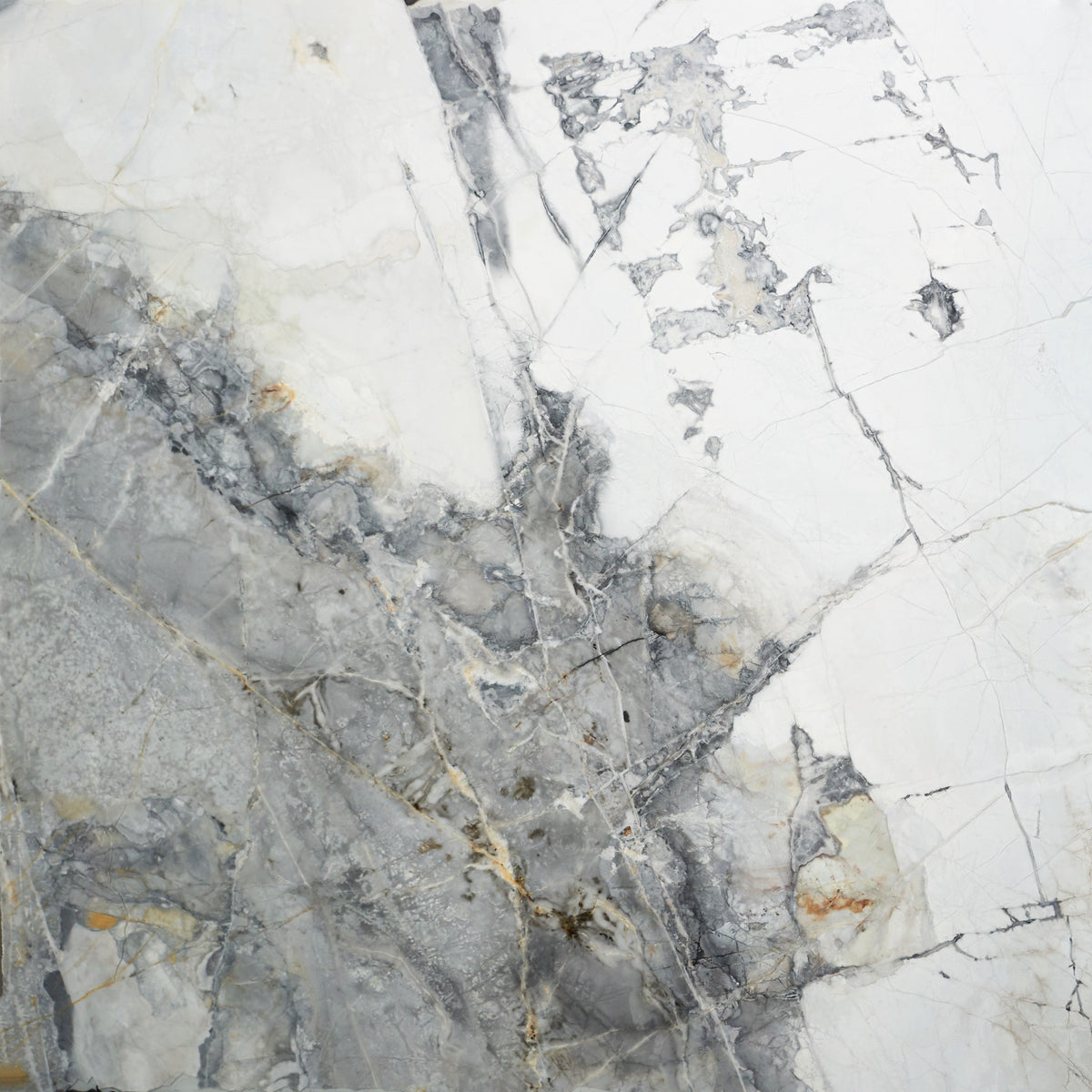
Invisible Grey

Pale grey with fine veining – a quiet marble from Italy.

Invisible Grey is a marble from Italy, the country whose quarries have set the standard for marble since antiquity. It is a true marble: carbonate rock that recrystallised completely under pressure and heat deep in the Earth’s crust. Fine veining runs across its pale grey ground, and no two veneers are alike.

All about Invisible Grey →
Quarry
Italy
Rock
Marble
Finish
poliert
03 / 05

India

4 stones Jaipur · Rajasthan

Black Rock

Deep black, matte and textured to the touch – slate from the Jaipur region.

Black Rock is a slate from the Jaipur region in Rajasthan, India. Slate forms differently from marble: clay mud was pressed into stone over millions of years and layered into wafer-thin sheets – and it is exactly these layers that can be split. That is why slate has always been the thin stone: the roofs of half the continents are covered with it. We split it thinner still than any roofer ever has.

All about Black Rock →
Quarry
Jaipur, Rajasthan · India
Rock
Slate
Finish
gespalten

Indian Summer

Rust, amber and ochre – a slate in the colours of autumn.

Indian Summer is a slate that shows colour where others stay grey. Its tones of rust, amber and ochre come from iron oxides that entered the clay layers as the rock formed – the same chemistry that colours autumn leaves, only in stone. Because the iron was distributed differently in every layer, no veneer resembles the next: sometimes bands, sometimes clouds, sometimes a single rust-red fleck.

All about Indian Summer →
Quarry
Rajasthan · India
Rock
Slate
Finish
gespalten

Transocean

Blue and grey-green in soft waves – a slate that recalls water.

Transocean is a slate whose pattern recalls water: blues and grey-greens lie in soft waves on top of each other, broken by pale lines like foam. The colours come from chlorite and fine iron minerals that sorted themselves into layers as the clay mud settled – the sea from which the stone was born has left its own image in it. Every veneer shows a different piece of that current.

All about Transocean →
Quarry
Rajasthan · India
Rock
Slate
Finish
gespalten

Vulcano Dust

Dark grey, finely grained and velvety matte – the slate of the Pro series.

Vulcano Dust is the slate of the Pro series: dark grey to anthracite, with a fine, even grain that looks like cooled ash. Unlike strongly layered slates it shows hardly any banding – instead a velvety, almost powdery texture. It formed from especially fine clay mud that settled calmly and evenly before pressure and time turned it to stone.

All about Vulcano Dust →
Quarry
Rajasthan · India
Rock
Slate
Finish
gespalten
04 / 05

Brazil

1 stone

Black Venom

Black with pale veins – denser and more scratch-resistant than marble.

Black Venom is a quartzite from Brazil – and quartzite is marble’s harder brother. It forms when sandstone, deep in the Earth’s crust, fuses under pressure and heat into an almost pure quartz rock. The result is denser than marble, more scratch-resistant and less sensitive to acids. The pale veins running through the black are quartz and feldspar that crystallised in cracks – hence the name: they look as if venom had shot through the stone.

All about Black Venom →
Quarry
Brazil
Rock
Quartzite
Finish
poliert
05 / 05

Afghanistan

1 stone

Lapis Lazuli

Luminous blue with golden pyrite – the stone that became ultramarine.

Lapis lazuli is not marble but a semi-precious stone – a rock of the blue mineral lazurite, flecked with golden pyrite and white calcite. Our lapis comes from Afghanistan, from the mountains of the Hindu Kush, where it has been mined for over 6,000 years: the Egyptians laid it in Tutankhamun’s tomb, and ground lapis became the ultramarine with which Vermeer painted the headscarf of his “Girl with a Pearl Earring” – a pigment then worth more than gold.

All about Lapis Lazuli →
Quarry
Afghanistan
Rock
Lapis lazuli (lazurite with pyrite and calcite)
Finish
poliert